Friday, September 14, 2012

The Flawed Evidence for Evolution


In a previous post I explained why Darwinism is False. In this post I will explain why the evidence for evolution is flawed.

The article A Primer on the Tree of Life by Casey Luskin discusses the scientific research into the evolutionary relationships between species. The evolutionary relationships between species are determined by examining how similar species are with respect to one or more characteristic. Species that are most similar are believed to be most closely related evolutionarily. These evolutionary relationships can be illustrated with a tree of life. Each new species formed during evolution is represented by a fork in a branch on the tree of life and the new species is represented by a new branch. This illustrates the belief that a new species evolves from only one other species and the resulting two species, the original species and the newly evolved species, are shown on the tree by the two branches of the fork.

If the theory of evolution is correct, then when you examine different characteristics of organisms they should show the same evolutionary relationship between species. However what scientists have discovered is that when they examine different genes they find that they may indicate different trees of life. This contradicts the theory that a new species evolves from only one other species. The theory of evolution cannot explain how a species could evolve from more than one other species.

Someone may say that some of the similarities between species are due to common ancestry while other similarities are due to convergent evolution - where similar environmental factors lead to the evolution of similar characteristics. This could explain why a species might seem closer to one species when one characteristic is examined and closer to another species when a different characteristic is examined. However the theory of evolution says that all species evolved from a common ancestor. If there is no way to tell which characteristics are due to common ancestry and which are due to convergent evolution, if there is no way to tell which species evolved from which, then there is no evidence for evolution.

Casey Luskin provides detailed evidence and a thorough discussion of it in the body of the article, but he sums it up well in the conclusion:

The methodology for inferring common descent has broken down. Proponents of neo-Darwinian evolution are forced into reasoning that similarity implies common ancestry, except for when it doesn’t. And when it doesn’t, they appeal to all sorts of ad hoc rationalizations to save common ancestry. Tellingly, the one assumption and view that they are not willing to jettison is the overall assumption of common ancestry itself. This shows that evolutionists treat common descent in an unfalsifiable, and therefore unscientific and ideological, fashion.

Meanwhile, as far as the data is concerned, the aforementioned New Scientist article admits, “Ever since Darwin the tree has been the unifying principle for understanding the history of life on Earth,” but because “different genes told contradictory evolutionary stories,” the notion of a tree of life is now quickly becoming a vision of the past — as the article stated “today the project lies in tatters, torn to pieces by an onslaught of negative evidence. Many biologists now argue that the tree concept is obsolete and needs to be discarded,” and as scientists quoted in the article said, “We have no evidence at all that the tree of life is a reality” or the tree is being “annihilated.” Perhaps the reason why different genes are telling “different evolutionary stories” is because the genes have wholly different stories to tell, namely stories that indicate that all organisms are not genetically related. For those open-minded enough to consider it, common design is a viable alternative to common descent.


Copyright © 2012 by ncu9nc All rights reserved. Texts quoted from other sources are Copyright © by their owners.

Thursday, September 13, 2012

Skeptics ignore the results of their own research when it conflicts with their beliefs.


I've updated my web page on Skeptical Misdirection to include the following:

Skeptical Investigations explains how the skeptical organization CSICOP while trying to debunk astrology, actually found evidence supporting astrology and "In order to get the result they wanted, ... had to commit a total of six statistical blunders...".

The statistician and psychologist Michael Gauquelin had done a statistical analysis providing evidence that astrology might have some basis in fact. His analysis showed a correlation between the position of Mars in the sky at the time of birth and the odds of a person becoming a sports champion...

In 1976, in an attempt to make this embarrassment go away once and for all, Harvard professor of biostatistics and CSICOP fellow Marvin Zelen proposed a simplified version of the original Gauquelin study which he subsequently performed with the assistance of CSICOP chairman and professor of philosophy Paul Kurtz and George Abell, a UCLA astronomer. In order to get the result they wanted, the trio had to commit a total of six statistical blunders, which are discussed in detail in the article The True Disbelievers: Mars Effect Drives Skeptics to Irrationality by former CSICOP fellow Richard Kammann. Proper analysis showed that the new study actually supported the Gauquelin effect.


Copyright © 2012 by ncu9nc All rights reserved. Texts quoted from other sources are Copyright © by their owners.

Wednesday, September 12, 2012

Belief in Physicalism is Unscientific


I have updated my web page on Skeptical Fallacies with the following entry:

One of the common reasons skeptics give for belief in physicalism is that there is no theoretical model to explain psychic phenomena, the afterlife, or how consciousness might not be produced by the brain. This is not sound logic. This is no reason to prefer physicalism over dualism or idealism. Physicalism offers no explanation for consciousness and there is a huge amount of empirical evidence for psychic phenomena and the afterlife that is impossible under physicalism but is consistent with dualism or idealism. Rather than ignore empirical observations, which would be unscientific, most people recognize that dualism or idealism is a better model than physicalism.

Copyright © 2012 by ncu9nc All rights reserved. Texts quoted from other sources are Copyright © by their owners.

Tuesday, September 11, 2012

Skepticism, The Big Lie. Activist Skeptics and Atheists are a Danger to the Health and Well Being of Believers.


If you think all skeptics are honest truth seekers, then you need to read my web page on Skeptical Misdirection. There is overwhelming evidence for the afterlife and psychic phenomena. The skeptical atheist view that consciousness is produced by the brain is an absolute fraud. Skeptics claim to be interested in truth. This is the Big Lie of our time.

However the problem is not just that skeptics and atheists are spreading misinformation.

Research shows that belief in the paranormal and religion can be conducive to the health and well being of people. These beliefs can help people cope with grief, divorce, job loss, the fear of death, particularly in the terminally ill, and can deter suicide. Therefore, when skeptics and atheists try to convince people to stop believing in the paranormal and religion, they may be doing harm to other people. Furthermore, research also shows that having meaning in life is necessary for people to thrive but skeptics claim consciousness and meaning are illusions. When skeptics spread their philosophy of materialism they may cause harm by taking the meaning and purpose of life away from people.

I am not saying anyone, skeptic, atheist, or believer should change their beliefs because of this research. You should believe what you think is right.

Also, I am not saying all skeptics and atheists are bad people. We all incarnate for different purposes, to learn different lessons. Some people need to have the experience of being a skeptic or an atheist. I went through a period of my life where I was a materialist atheist and during that time I formed a highly developed sense of ethics. That sense of ethics is much more valuable to me than one based on fear of karmic retribution or punishment in the afterlife. I follow those values because I know they are right not because I am afraid to do otherwise. I had to have the experience of being a materialist to develop those values.

However, if your beliefs are dangerous to another person, if they will harm his health and well being, you should not go on a crusade to convert him to your way of thinking. If someone is grieving, or suffering from a terminal illness, or feeling suicidal, you shouldn't try to convert him to materialism. But it is not just the afterlife. The references I link to below show religion can help if you are going through a divorce or have lost your job. These are not theoretical points. Real people experiencing real suffering can be harmed by activist skeptics.

I realize this attitude may upset some skeptics. However my overriding concern is to protect people from being harmed by skeptics and atheists.

Below I include links, quotes, and references to research that shows how helpful religion and belief in the paranormal can be to people. But I also know this from my own experience. I have been to many Spiritualist church services and I've seen what I am writing about first hand. Many people come to a Spiritualist church for the first time when they are suffering from grief because mediumship is part of the Sunday service. Some of these people are suffering from extreme grief from the death of a spouse or a child. Losing a child is one of the most difficult of all things to have to experience in life. During church services, I've seen and heard with my own senses the comfort and relief that a communication from a deceased loved one can give to another person.

Imagine a child conceived in love, who you carried in pregnancy, gave birth to, fed from your own breast, and raised from infancy. Who you taught to walk and talk and took to their first day of school and had birthday parties for. Who you loved and who loved you and trusted you completely in their innocent childlike way. Imagine your hopes and dreams for their future. Now, imagine their life is cut short, maybe by a sudden accident or a lingering illness. Actually, you can't imagine the grief and sense of loss a parent would feel in that situation. Now try to imagine what it is like for that parent to know that their child's existence has not been cut short but that their child is living with Grandma in another plane of existence, and they can still know about each other and communicate words of love.

I've been there during Spiritualist church services and seen and heard a medium provide this comfort to people suffering from extreme grief. I knew the medium, I knew the church, I know it wasn't cold reading or hot reading and I know the information the medium gave to identify the spirit was specific, detailed, and impossible to guess by chance.

So I also know the harm that can be done by skeptics who never had this experience and who don't know what they are talking about when they try to convince someone else that it is all a delusion or a fraud.

The people who are deluded and who are committing fraud are the skeptics and atheists. There is overwhelming evidence for the afterlife and the skeptical atheist view that consciousness is produced by the brain is an absolute fraud. Skeptics claim to be interested in truth. This is the Big Lie of our time.

References

Here are links, quotes, and references to back up my assertions about the benefits of belief in the paranormal and religion:

An Exploratory Study of the Effects of Paranormal and Spiritual Experiences on Peoples' Lives and Well-Being by J.E. Kennedy and H. Kanthamani,Original publication and copyright: The Journal of the American Society for Psychical Research, 1995, Volume 89, pp.249-265.

Recent research suggests that a world view that is open to aspects of life beyond the physical-materialistic realm can be conducive to health and well-being ....

Religion 'linked to happy life' from news.bbc.co.uk.

...

Professor Clark said: "We originally started the research to work out why some European countries had more generous unemployment benefits than others, but our analysis suggested that religious people suffered less psychological harm from unemployment than the non-religious.

"They had higher levels of life satisfaction".

...

Even though churchgoers were unsurprisingly more likely to oppose divorce, they were both less psychologically affected by marital separation when it did happen, he said.

"What we found was that religious people were experiencing current day rewards, rather than storing them up for the future."

...

But Justin Thacker, head of Theology for the Evangelical Alliance, said that there should now be no doubt about the connection between religious belief and happiness.

"There is more than one reason for this - part of it will be the sense of community and the relationships fostered, but that doesn't account for all of it.

"A large part of it is due to the meaning, purpose and value which believing in God gives you, whereas not believing in God can leave you without those things."

Are Religious People Happier than Atheists? by By Susan Perry at minnpost.com

In fact, some research has found that people who regularly attend religious services can expect to live an average of seven years longer than their peers who never step inside a church, synagogue or mosque.

...

New research has found “that the positive effects of religion depend enormously on where you live,” writes Upson. “Religious people may be happier than their godless counterparts, but only if the society they belong to values religion highly, which not all societies do.”

Bereavement and belief in the Afterlife from candidaabrahamson.wordpress.com

Grief from the loss of a loved one is often overwhelming and crushing. Religions often try to ease that gaping sense of emptiness through ritual aimed at facilitating gradual release. And the literature on the positive effects of religion on healing is significant. Becker, in his 2007 paper, “Do religious or spiritual beliefs influence bereavement?: A systematic review,” analyzed 32 studies, covering a total of 5715 persons. 94% of the studies showed some positive effects of religious or spiritual beliefs on bereavement [all references below].

...

There is a comfort that a belief in life after death brings, and it allows the belief holder to better reconcile his loss, to be less gripped by overwhelming fears, to adapt better, and, in some cases, to recover faster.

...

Becker G. Do religious or spiritual beliefs influence bereavement?: A systematic review.” Palliative Medicine 2007; 21(3):207-217.

Billings AG, Moos RH. The role of coping responses and social resources in attenuating the stress of life events. Journal of Behavioral Medicine, 1981: 4(2):139-157.

Braun M, Berg D. Meaning reconstruction in the experience of parental bereavement. Death Studies 1994; 18(2):105-29.

Clarke SM, et al. Religiosity, afterlife beliefs, and bereavement adjustment in adulthood. Journal of Religious Gerontology 2003; 14(2):207-224.

Davis C, Nolen-Hoeksemea S. Loss and meaning: How do people make sense of loss. American Behavioral Scientist 2001; 44(5):726-741.

Schoenrade P. When I die…Belief in afterlife as a response to mortality. Personality and Social Psychology Journal 1989; 15(1):91-100.

Smith P, Range L, Ulmer A. Belief in afterlife as a buffer in suicidal and Other bereavement. OMEGA–Journal of Death and Dying 1991-92; 24(3):217-225.

Lessons from the Light by Kenneth Ring and Evelyn Elsaesser. The link goes to a page in the book that describes how knowledge of Near Death Experiences deters suicide.
As far as I know, the first clinician to make use of NDE material in this context was a New York psychologist named John McDonagh. In 1979, he presented a paper at a psychological convention that described his success with several suicidal patients using a device he called "NDE bibliotherapy." His "technique" was actually little more than having his patients read some relevant passages from Raymond Moody's book, Reflections on Life after Life, after which the therapist and his patient would discuss its implicatins for the latter's own situation. McDonagh reports that such an approach was generally quite successful not only in reducing suicidal thoughts but also in preventing the deed altogether.

...

Since McDonagh's pioneering efforts, other clinicians knowledgeable about the NDE who have had the opportunity to counsel suicidal patients have also reported similar success. Perhaps the most notable of these therapists is Bruce Greyson, a psychiatrist now at the University of Virginia, whose specialty as a clinician has been suicidology. He is also the author of a classic paper on NDEs and suicide which the specialist may wish to consult for tis therapeutic implications. (14)

Quite apart form the clinicians who have developed this form of what we migh call "NDE-assisted therapy," I can draw upon my own personal experience here to provide additional evidence of how the NDE has helped to deter suicide. The following case ...

Materialism: Meaning is an illusion. Science: People need meaning to thrive.

Copyright © 2012, 2015 by ncu9nc All rights reserved. Texts quoted from other sources are Copyright © by their owners.

Saturday, September 8, 2012

Physicalism is Dead: Paranormal Interest and Well-Being

Physicalism is Dead: Paranormal Interest and Well-Being: People who are actively interested in parapsychology and have had experiences they interpret as paranormal or transcendent report that thes...

Friday, September 7, 2012

Update to Objects That Contain Healing Power


I posted an update to Objects That Contain Healing Power. Scroll to the bottom of the post to get to the update. The update describes another experiment I did in which healing energy is stored in a plastic jar and used it to turn an Egely wheel (a very sensitive psi wheel).


Copyright © 2012 by ncu9nc All rights reserved. Texts quoted from other sources are Copyright © by their owners.

Thursday, September 6, 2012

An Easy Altered State


Recently, the topic of altered states came up on a discussion forum I participate in. I posted this information...

One easy way to experience an altered state is to just observe yourself as you fall asleep at night and try to notice when you are in the hypnogogic state. When that happens it is very hard to concentrate on one thing for more than a few seconds and you have very vivid mental imagery.

If you try repeating a phrase over and over as you fall asleep, (or while you are doing relaxation exercises), you get to a point where you can't concentrate on it for more than a few seconds without your mind wandering and at the same time you experience very vivid mental imagery. Then you are in the hypnogogic state and your brain is probably producing lots of theta waves. Theta waves have been reported to coincide with psychic experiences.

I find the hypnogogic state is a good state for doing remote viewing and spirit communication. I explain this in more detail on my web site.

If you don't want to get too spooky, just consider the hypnogogic state a good state to access the unconscious. If you have a personal or spiritual question, repeat the question over and over and when your mind wanders and you have mental imagery, see if there isn't an answer or symbolic answer somewhere in the mental noise.

Copyright © 2012 by ncu9nc All rights reserved. Texts quoted from other sources are Copyright © by their owners.

Wednesday, September 5, 2012

T. H. Huxley: Accidental Founder of Modern Pseudo-skepticism


The majority of Americans believe in psychic phenomena. People usually believe in psychic phenomena and the afterlife because of their personal experiences, the experiences of people they know, or their religious beliefs. Unfortunately, there is still a lot of ignorance about the evidence for afterlife and the evidence for psychic phenomena.

There are also many people who are drawn to skepticism for several reasons. Because skeptics are influential, politicians and scientists are afraid to acknowledge belief in psychic phenomena and the afterlife or to advocate increased research in those fields.

This is a problem for Science and a problem for Humanity. What could be of greater significance to science than the huge gaps in our understanding of the universe that are revealed by our inability to explain psychic phenomena? What could be more important to humanity than an understanding of the survival of consciousness after death?

If most Americans believe in psychic phenomena, why do skeptics have such a disproportionate influence in society?

A large part of the problem is that the many scientists are skeptics and they have a lot of influence on our culture in many different areas: they advise politicians, they publish popular books, they control research funding, they influence the editorial policy of scientific journals, they consult for the news and entertainment media, etc etc. Because science has been so successful in modern times giving us improved medical care, agriculture, transportation, communication, and many other technologies, the opinions of scientists are highly respected. But the biggest problem is that scientists persecute any scientist who shows an interest in anything paranormal. This is what is really stifling greater acceptance of psychic phenomena in society and what is preventing more money from being spent on parapsychological research. Scientists' skepticism also gives moral authority to anyone else who also advocates skepticism.

Why are so many scientist skeptics? Because naturalism is an implicit part of the culture of science and science students are indoctrinated in that philosophy during their education. Naturalism is the belief that science should only study natural processes and consider natural explanations for phenomena. This is a mistake. Science should be the search for the truth where ever it leads. This flaw in the culture of science is due to a large extent to T. H. Huxley and the X club. The X Club was Founded by T. H. Huxley and played an important role in making naturalism a fundamental tenet of modern science.

The nine men who would compose the X Club already knew each other well. By the 1860s, friendships had turned the group into a social network, and the men often dined and went on holidays together. After Charles Darwin's On the Origin of Species was published in 1859, the men began working together to aid the cause for naturalism and natural history.

...

More importantly, the men of the club all shared an interest in natural history, naturalism, and a more general pursuit of intellectual thought free from religious influence, commonly referred to as academic liberalism.

- Wikipedia

One of the great successes of the X Club was engineering the supremacy of Darwinsim over the theories of Alfred Russel Wallace who also discovered the theory of natural selection. Darwin was an agnostic who believed in naturalism. Wallace was a Spiritualist.

Why isn’t Wallace remembered like Darwin?

The reasons are complex but largely related to the complete and sweeping dominance of Darwinian evolution. From the very beginning, when the theory of natural selection was unveiled to the scientific community at the Linnean Society on July 1, 1858, the entire program was engineered by Darwin’s colleagues and close friends, Joseph Hooker and Charles Lyell, to give their friend priority. When Origin was published a little over a year later modern evolutionary theory became Darwin’s theory. Another of Darwin’s allies, his “Bulldog” defender Thomas Henry Huxley, sought to solidify the theory by managing its every promotional and public aspect so as to gain paradigmatic status for it within the scientific community. In order to facilitate this end, Huxley composed the X Club, a group of eight kindred spirits: Huxley (the leader), Joseph Hooker, John Tyndall, George Busk, Edward Frankland, Herbert Spencer, Thomas Hirst, and John Lubbock. Under Huxley’s skillful management the X Club ensured the success of Darwinism, establishing it as the preeminent theory of biological life first in England and later throughout all of Europe. As if this weren’t enough to consign Wallace to obscurity, his insistence upon using the term “Darwinism” in the context of his own very different theory tended only to cause confusion and misunderstanding. Today, when Wallace is mentioned at all it is usually through a decidedly Darwinian lens.

http://www.alfredwallace.org/faqs.php

This conspiratorial tradition continues today in the persecution of scientists who criticize Darwinism, advocate intelligent design, or suggest psychic phenomena are real and are deserving of scientific study.

The formation of the X Club was happening during the second half of the 19th century, also the time the Society for Psychical Research was getting started. Huxley did not want studies of psychic and Spiritualist phenomena to become part of science.

The only good that I can see in the demonstration of the truth of "Spiritualism" is to furnish an additional argument against suicide. Better live a crossing-sweeper than die and be made to talk twaddle by a "medium" hired at a guinea a séance.

Review in the Daily News (17 October 1871), quoted in Life and Letters of Thomas Henry Huxley F.R.S (1900) edited by Leonard Huxley, Vol. 1, p. 452.

http://en.wikiquote.org/wiki/Thomas_Henry_Huxley

Because of T. H Huxley and the X club, naturalism has become so ingrained in modern scientific culture and education, students don't even realize they are being indoctrinated. Because of this, Huxley can be considered a major cause of modern of science's intolerance to psychic phenomena and the source of modern pseudo-skepticism.

It is unfortunate that Darwin was used this way in the adoption of philosophical naturalism and materialism by the scientific establishment. Materialism is a gross misrepresentation of Darwin's thinking. Darwin believed that natual laws were designed - which is a form of intelligent design. Darwin also doubted human reason could be reliable if it arose through natural selection. If you cannot trust reason, then it is not rational to believe in anything including materialism. This argument is a well known flaw in materialism whereby materialism refutes itself. Darwin's beliefs did not support materialism yet his theory of natural selection is a keystone in the philosophy of materialisim because it provides materialism with an explanation of how complex organisms arose naturally.

Because naturalism is such an integral part of the scientific worldview, working as a scientist tends to brainwash a person into believing in physicalism. This is because scientists spend all their time trying to find physicalist solutions to problems. They get stuck thinking that way and can't conceive there might be something that current science can't explain or that there could be significant gaps in scientific knowledge. Like the proverbial man with a hammer to whom everything looks like a nail, to a scientist every question must have a physicalist answer.

Another part of the problem of skepticism is anti-religious fanatics, some of whom are also scientists. They have been injured in some way by religion and are out for vengeance. Anything that contradicts their humanist worldview is labeled religion and equated with ignorant religious fundamentalism and labeled a threat to modern enlightened rational society. Many of these people are "activists" who use the moral authority of the scientists to justify their militancy. Skeptics are not smarter than other people, they just claim they are and use that to justify their beliefs. However, people who have more education are more likely to believe in the afterlife and ESP and most doctors believe in the afterlife.

A third source of the problem of the inordinate influence of skepticism is the government suppression of parapsychology.

Because the skeptical attitudes of scientists give moral authority to the anti-religious fanatics and allow the government to use scientists as pawns in their suppression of parapsychology, the root cause of the influence of skepticism in society stems from the intolerance of scientists. This intolerance originates in the belief in naturalism. T. H. Huxley was not a pseudo-skeptic, and it is sadly ironic that his good intentions have had such unfortunate consequences.

Copyright © 2012 by ncu9nc All rights reserved. Texts quoted from other sources are Copyright © by their owners.

Tuesday, September 4, 2012

Is Self-directed Neuroplasticity Evidence That Consciousness is not Produced by the Brain?


There is a lot of discussion on an internet forum I follow about self-directed neuroplasticity. Some people feel that self-directed neuroplasticity is evidence that consciousness is not produced by the brain.

I disagree with this opinion.

Self-directed neuroplasticity is the phenomenon whereby the brain is altered by conscious thought. Meditation and cognitive therapy are conscious processes that have been shown to alter the brain.

However, some people believe the brain cannot be capable of modifying itself and therefore self-directed neuroplasticity shows that consciousness must be independent from the brain.

The reason I don't consider this to be correct is as follows:

  1. Ordinary neuroplasticity is not controversial. Neurons in the brain alter their connections during any process that involves learning.

  2. If you want to demonstrate that self-directed neuroplasticity is different from ordinary neuroplasticity and is evidence that consciousness is not produced by the brain, you have to start from the premise that consciousness is produced by the brain and try to show that premise leads to a contradiction. If you start from the premise that consciousness is not produced by the brain you are starting from the point you are trying to prove. Those who believe that self-directed neuroplasticity is evidence that consciousness is not produced by the brain often ask "who is doing the meditation that alters the brain" - as if this implied consciousness was not produced by the brain. However that implication is the point to be proved not an assumption you can start with.

  3. Self-directed neuroplasticity, like the placebo effect, demonstrates that consciousness can influence the brain and therefore consciousness is not an illusion or an epiphenomenon of the brain.

  4. Do the two statements 1) consciousness is produced by the brain, and 2) consciousness is not an illusion or an epiphenomenon of the brain - constitute a contradiction?

  5. No. Consciousness might be produced by the brain and also influence the brain. For example, one part of the brain might influence another part of the brain. As an analogy, a computer system or network of computers can be programmed to allocate and reallocate resources depending on changing usage requirements. You could try to refute this point by saying in self-directed neuroplasticity consciousness alters the part of the brain that is responsible for consciousness. If you do that, you are admitting that the brain produces consciousness which is what you are trying to disprove.

  6. You cannot argue that it is impossible for the brain to alter itself, because in self-directed neuroplasticity consciousness has effects on the brain that alter consciousness. Cognitive therapy and meditation are both conscious processes that alter the brain and have effects on consciousness. If consciousness can alter itself, which is not in dispute, you are admitting there are conscious systems that can alter themselves and therefore there are no grounds to argue that the brain cannot produce consciousness and alter itself.

  7. Therefore self-directed neuroplasticity, whereby consciousness alters the brain, does not provide evidence that consciousness is not produced by the brain.

I think there is so much confusion over this issue because people who believe consciousness is not produced by the brain bring that opinion to the debate and they don't realize how it influences their reasoning. They start from that premise and don't realize it. They often refer to some other phenomenon that is evidence consciousness is not produced by the brain as if it bolstered their argument. But that is just another way of assuming the premise they are trying to prove or proving the premise by alternate means. In order to show self-directed neuroplasticity is evidence that consciousness is not produced by the brain, you have to start from the premise that consciousness is produced by the brain and try to show that leads to a contradiction. Otherwise you are starting with the premise you are trying to prove. However as I have tried to show above, that premise does not lead to a contradiction.

However there is a large amount of evidence from other phenomena that does show consciousness is not producecd by the brain.

Further reading on self-directed neuroplasticity:

Copyright © 2012 by ncu9nc All rights reserved. Texts quoted from other sources are Copyright © by their owners.

Tuesday, August 28, 2012

Skeptics Whose Critical Thinking Skills are Stunted by Church Logic


A common reason some skeptics seem unwilling and unable to consider the evidence for the afterlife and psychic phenomena is because their critical thinking skills are stunted because of their overly religious upbringing. These skeptics are skeptical mainly because they were brought up in an oppressive religious environment and later in life they came to reject that religion and everything related to the supernatural. Most of these types of skeptics are what I call victims of Christianity, and have had their logical faculties stunted by what I call "Church Logic".

Many religions are not receptive to questions about dogma. When someone asks an inconvenient question they are fed a canned response that is not very logical and they are discouraged from pursuing the matter. This type of logic pervades their cultural environment while they are growing up and it has the effect of preventing them from distinguishing rhetoric from substance. They learn that the answer to a question is something you memorize rather than understand.

They may eventually become skeptics and reject their religion and its dogma, but they still don't have the reasoning ability to see that thinking clearly involves more than just trotting out a pat answer. They have gone from one form of extreme dogmatism to another because that is the only way they are capable of thinking. Instead of addressing the evidence for the afterlife and psychic phenomena in detail and with specificity they dismiss it with dogmatic phrases like "it's pseudoscience", "he is a woo merchant", or "the plural of anecdote is not data". They have a huge blind spot when it comes to logical reasoning because they never developed the ability when their brains were still young, developing, and flexible. They have a glaring ignorance of the evidence for the afterlife and psychic phenomena but they can't see that they are hide bound because they have no other way of thinking about controversy except through memorized dogmatic answers.

Copyright © 2012 by ncu9nc All rights reserved. Texts quoted from other sources are Copyright © by their owners.

Materialism Cannot Explain Consciousness


It is very easy to demonstrate that materialism cannot explain consciousness. First, show that none of the materialist explanations for consciousness are valid:

Next, provide evidence that consciousness is not produced by the brain or any physical process and that it survives death:

Then, preemptively refute the skeptical criticisms of this evidence:

Copyright © 2012, 2014, 2016 by ncu9nc All rights reserved. Texts quoted from other sources are Copyright © by their owners.

Monday, August 27, 2012

Video Showing Stored Healing Energy Turning a Psi Wheel

I added two videos to my previous post Objects That Contain Healing Power

One video shows an Egely wheel (a very sensitive psi wheel) turning under a jar, the other video shows that the wheel starts to turn when the jar is placed near it.

Saturday, August 25, 2012

Objects That Contain Healing Power


This is the fourth post in my series on psi wheels.

In the first post, I discussed how everyone can measure the energy field surrounding their body with a psi wheel and how to use a psi wheel to measure this energy as you bring it into and through your body when you practice spiritual healing. In the second post, I discussed how the psi wheel shows that the energy in the field surrounding the body is the same as the energy that flows through you when you give spiritual healing to another person. In the third post I discussed using qi gong to increase the flow of healing energy (qi) through your body to help develop your abilities as a spiritual healer.

In this post I will discuss how to use an Egely wheel (a very sensitive psi wheel manufactured by the Egely Research Company) to demonstrate that healing energy can be stored in inanimate objects.

(The Videos shown below are only provided to illustrate the apparatus and phenomena that I have written about for those who are interested and who may want to try reproduce it themselves. The videos are too short in length and too close to the subject to be considered as proof of the phenomena. Since it is impossible to proving anything with a video, I have no plans to make more convincing videos. The proof of the phenomena will come when others reproduce them. One of the phenomena, turning a psi wheel covered by a jar by placing a hand on the jar, has been reported by many others. I am not aware of anyone else who has reported the second phenomenon: using the jar by itself to turn the wheel.)

When I first learned spiritual healing at a Spiritualist church I was taught that a healer can put healing energy into an inanimate object and then if another person holds that object, the healing energy will be transferred to the other person. I was able to test and confirm part of this belief using an Egely wheel. I was doing a healing meditation and monitoring the flow of healing energy with an Egely Vitality Meter. This is a very sensitive psi wheel. To be totally certain that no air currents were influencing the wheel I used a jar turned upside down to cover the wheel. The jar was made out of plastic, recycle number 1, PETE. I put my hand on the jar to spin the wheel. This is a very inefficient way to turn a psi wheel and the wheel turns much slower when covered with a jar - which is why I use the more sensitive Egely wheel when doing this rather than my homemade psi wheels. While this was occurring, I took the following video of it:


After meditating this way for twenty minutes, ten minutes with each hand turning the Egely wheel under the jar, I tried an experiment to see if the jar had retained any healing energy. I took away the jar covering the Egely wheel and waited for it to stop turning. Then I placed the jar near the wheel and took my hand away from it. The Egely wheel began to turn. While I did this, I took the video of it shown below. After several rotations I moved the jar away from the wheel and it soon stopped turning. I put the jar near it again and it began to turn once more. Another time, I let the jar turn the wheel for ten minutes. This length of time would rule out the possibility that the motion was caused by air currents created when the jar was placed near the wheel. I then took the jar away and the wheel stopped turning after a few seconds. Since the wheel stopped turning when the jar was removed, it is unlikely that air currents could be the cause of the movement of the wheel when the jar was next to it. I put the jar back and the wheel resumed turning and continued to turn for several minutes until I stopped the experiment.


This phenomenon is consistent with another observation about psi wheels. Psi wheels seem to turn in the opposite direction when they are under a jar than when they are uncovered and exposed directly to a hand. Usually, a psi wheel will turn clockwise when the left hand is placed near it and counterclockwise when the right hand is placed near it. However, if a jar is placed over the wheel, the wheel will turn clockwise when the right hand is placed near it and counterclockwise when the left hand is placed near it. This phenomenon suggests that the wheel is not turning inside the jar because some force field from the hand penetrates the jar, but because the force field from the hand induces a field in the jar - like two gears that turn in opposite directions when their teeth mesh. Interestingly the Egely wheel (and a home psi wheel to a lesser extent) is shaped like a gear. If a field is induced in the jar, it seems possible that the jar might retain the field once the hand was taken away as if it was magnetized (a la Franz Mesmer). This would explain why the jar without a hand near it would also cause the psi wheel to turn, whereas if it was simply the energy from the hand penetrating the jar that turned a covered wheel, that would not explain why a jar could turn a wheel without a hand near it.

These observations seem to confirms the belief that healing energy can be stored in inanimate objects. There is some scientific evidence in this area. Dean Radin published an article, Effects of Intentionally Enhanced Chocolate on Mood in the Elsevier journal Explore: The Journal of Science and Healing, Volume 3, Issue 5, Pages 433-546 (September 2007), which describes how chocolate which had been prayed over elevated the mood of the people who ate it.

Update 9/5/12: I tried a slightly different experiment today. First I placed the plastic jar near the Egely wheel to make sure it did not have any residual "magnetism". Then, I did the healing meditation for five minutes turning two homemade psi wheels, one with each hand. Next, I stopped using any psi wheel and continued meditating with my right hand on the plastic jar in the same position as if it had the Egely wheel under it but without the wheel. After ten minutes with my hand on the jar, I placed the jar next to a stationary Egely wheel and took my hand away. The wheel began to spin counterclockwise and continued to turn until I moved the jar away after five minutes, then the wheel stopped turning.


Copyright © 2012 by ncu9nc All rights reserved. Texts quoted from other sources are Copyright © by their owners.

Monday, August 20, 2012

Zerdini's World


Zerdini has started blogging at Zerdini's World. If you are interested in mediumship you will undoubtedly enjoy this blog. Zerdini has had vast personal experiences with some of the world's best mediums. Previously, he has posted and comented at various places on the internet but now his accumulated knowledge is being collected in one place. I've known him to be very helpful in answering questions and providing additional information, so if you have questions please don't hesitate to comment on his new blog.

About the Author:

I have over fifty years experience of mediumship having sat with some of the world’s finest mediums.

This website is about mediums and their mediumship – both mental and physical.

It has come about as a result of the many questions I’ve been asked on various blogs, forums and other websites.

There is a great deal of valuable information on mediumship, it is spread across many different sources. I decided to make some of my own experiences and knowledge available on one website so readers can make up their own minds, or at least begin the search for their own evidence.

Copyright © 2012 by ncu9nc All rights reserved. Texts quoted from other sources are Copyright © by their owners.

Sunday, August 19, 2012

Hearing Voices? Talk Back Politely.


Michael Prescott blogged about an interesting article, Living With Voices By T. M. Luhrmann, in theamericanscholar.org. It's about a treatment for people who hear disturbing voices that no one else can hear. The treatment involves talking back to the voices politely and respectfully. Read the article for full details.

Besides offering help for people with this type of disturbing experience, it is significant also because it offers a case where the skeptical view is wrong and the Spiritualist view is right. The skeptical approach to treating people who heard voices was to deny the reality of the voices and treat them as hallucinations. The Spiritualist approach to this problem was to treat the voices as spirits and help the spirits come to terms with their existence as spirits so they would stop bothering the patient.

There are several doctors that are well known for successfully using the Spiritualist approach even before this new treatment described in Luhrmann's article was developed: Carl Wickland (Thirty Years Among the Dead), Titus Bull, and Edith Fiore (The Unquiet Dead).

People may have different opinions about whether the voices are really spirits or hallucinations, nevertheless, this new research seems to confirm the work of Wickland, Bull, and Fiore, that the Spiritual approach, treating voices as if they are spirits, is better than the skeptical approach which is to consider the voices to be unreal hallucinations. Skeptics like to say they have the best interests of the public in mind, that they want to protect people from being fooled, when they insist on a materialist worldview. However, when it comes to helping people who hear voices, that worldview is not always in the best interest of the public. If a form of alternative medicine is an effective treatment and especially when it is superior to what is available from mainstream medicine, the skeptics are not doing anyone any good by calling those practitioners charlatans and quacks.

Related posts on this blog:

Copyright © 2012 by ncu9nc All rights reserved. Texts quoted from other sources are Copyright © by their owners.
Monday, August 13, 2012

Spiritual Healing Development with Qi Gong


This is the third post in my series on spiritual healing and the psi wheel. In the first post, I discussed how everyone can measure the energy field surrounding their body with a psi wheel and how to use a psi wheel to measure this energy as you bring it into and through your body when you practice spiritual healing. In the second post, I discussed how the psi wheel shows that the energy in the field surrounding the body is the same as the energy that flows through you when you give spiritual healing to another person. This post is about using qi gong to increase the flow of healing energy (qi) through your body to help develop your abilities as a spiritual healer.

You don't have take my word for it when I write these different statements about this energy. You can verify them for yourself using a psi wheel. You can measure the effects of qi gong on your energy field and your ability to move the energy through your body during spiritual healing by using a psi wheel before and after you do qi gong and during spiritual healing.

Qi gong is a part of traditional Chinese medicine. It includes exercises that enhance the energy field that surrounds your body and it improves the flow of that energy through your body. Since spiritual healing works by moving this energy through your body and into another person, doing qi gong will help you to develop your healing abilities and it is also a good way to prepare for a spiritual healing session.

From wikipedia:

Qigong, chi kung, or chi gung (literally "Life Energy Cultivation") is a practice of aligning breath, movement, and awareness for exercise, healing, and meditation.[1] With roots in Chinese medicine, martial arts, and philosophy, qigong is traditionally viewed as a practice to cultivate and balance qi (chi) or what has been translated as "intrinsic life energy".[2] Typically a qigong practice involves rhythmic breathing coordinated with slow stylized repetition of fluid movement, a calm mindful state, and visualization of guiding qi through the body.[3]

Below are instructions for a few qi gong exercises. I suggest doing eight repetitions of the moving exercises and holding the stationary positions for at least twenty breaths. There is no harm in doing more and you can do as much as you like. But for some people who are very busy, if they try to do too much it will become burdensome and they may give it up. It is better to do just a little bit than to do none at all.

  • Three Jiaos: HTML PDF

  • Lower Ball Rotation: Stand as in the Three Jiaos. Hold your hands at the level of your lower abdomen as if you were holding a ball about six or eight inches in diameter between your hands. Then rotate the "ball" clockwise so your left had is above your right hand. Then rotate the ball the other way so the right hand is above the left hand. Repeat this for several repetitions and synchronize the movement with your breathing. Notice the sensations in your hands.

  • The Full Circle: The web page says to do each position in The Full Circle for five minutes but I suggest in your first session you hold each position for twenty breaths and gradually increase that number if you want to in subsequent sessions. Twenty breaths is approximately one minute, you can time your breathing before you start if you want to be more precise. These exercises are similar to the qi gong exercises described in the book 15-minute Tai Chi (below).

  • Pulling Down the Heavens: There are several exercises similar to this one that you can do. Instead of raising you arms above your head, bring them to the forehead for several repetitions, then to the heart for several repetitions and then to the abdomen just below the navel for several repetitions. Then do the exercise shown at the link raising your arms straight above your head.

When you do qi gong exercises, notice the sensations you feel in your hands and your body. Try to feel your own energy field from within the body and also feel it from without your body with your hands. For example, if your hands pass across the area of your chest, notice sensations in your chest and the sensations in your hands as they pass through the energy field around your chest. Practicing in this way may allow you, in time, to develop the sensitivity needed to feel your own energy field and the energy fields surrounding other living things.

These exercises are just suggestions to introduce you to qi gong. A complete qi gong workout that will provide the maximum benefit to your energy field and flow of energy through you should include warm-up stretches to loosen the muscles and movements to loosen the joints, tone the muscles, and align the vertebrae. If you want to try a more complete workout that includes all of these components I would suggest one of these DVDs:

  • Chi Energy Workouts for Beginners by David Carradine

  • David Carradine's AM & PM Tai Chi Workout for Beginners by David Carradine

    Tai Chi Focus Relax Rejuvenate on youtube.

Chi is the same word as qi but spelled differently. Some of the advanced movements on the DVDs are complicated and may be difficult to learn but it is not necessary to do everything on a DVD (this is also true of the books below). The AM workout in the AM & PM DVD is very simple but is a complete workout.

Some books on qi gong I recommend are:

  • 15-Minute Tai Chi by John Ding and Alan Ding. This book includes several 15 minute workouts that include qi gong and tai chi. I combine all the qi gong exercise together and do those as part of my qi gong workout. They are very similar to the full circle linked to above.
  • Becoming One with Nature: Restore Yourself with Tai Chi by Martin Lee, Ph.D., Emily Lee, TC Master, Melinda & Joyce Lee
  • The Complete Idiot's Guide to T'ai Chi and QiGong Third Edition by Bill Douglas. See Part 3 which is about QiGong.

You can measure the effects of qi gong on your energy field by using the psi wheel. Notice if the psi wheel spins faster after you do qi gong than it spins before you do qi gong. Also notice if the psi wheel spins faster during spiritual healing practice if you do qi gong immediately before the spiritual healing practice.

Copyright © 2012, 2015, 2016 by ncu9nc All rights reserved. Texts quoted from other sources are Copyright © by their owners.

Saturday, August 11, 2012

The Psi Wheel and Spiritual Healing: What Does it Mean?

The Psi Wheel and Spiritual Healing: What Does it Mean?

Yesterday I posted about How to Use a Psi Wheel to Practice Spiritual Healing. That post has significant implications:

  1. The human body is surrounded by an energy field.
  2. This energy field can influence matter.
  3. The healing energy used in spiritual healing is probably the same type of energy.
  4. This energy can be controlled with the mind. The method of control is unknown because the precise nature of the energy is unknown. The manner of mental control might be something ordinary like the way the mind can control muscles, or it might be something more paranormal.

The phenomenon of the psi wheel turning when a hand is placed near it is something that occurs with almost everyone and no effort or intention is necessary for the wheel to turn. This has been shown by George Egely. Egely received a Ph.D. in the field of energy transfer and he conducted extensive research and could not find any scientific explanation for this. The phenomenon indicates that the human body is surrounded by an energy field and that energy field can influence matter and cause the wheel to turn.

During my experimentation with a psi wheel, I discovered that performing a spiritual healing meditation increases the effect that causes the psi wheel to turn. During my experiments, I made no intention to spin the psi wheel. When I performed the spiritual healing meditation, I only visualized the healing energy flowing through me and out from my hands. I made no conscious thought or mental effort toward making the wheel turn. The fact that visualizing this energy emanating from my hand increased the rate at which the wheel turned when my hand was placed near the wheel suggests that the energy involved in spiritual healing is the same type of energy that always surrounds the body and that during spiritual healing, this energy is emitted in greater amounts than normal. This is also consistent with the observation by Egely that people who are ill are less able to spin a psi wheel.

All of this suggests several areas for further research:

  • Studies could be done to look for a correlation between the rate of rotation a healer can induce in an Egely wheel (a psi wheel with electronics that measure the rate of spin) and positive outcomes of their healing sessions. If a correlation can be shown experimentally, then the Egely wheel could be used in future research to quantify the amount of healing applied by a healer. It also might provide a way to rate healers and that information could be useful to patients looking for spiritual healing practitioners.
  • The position of the wheel with respect to the body seems to affect the rate of spin. The wheels seem to spin faster when off to the side and not directly in front of the user. This suggests that spiritual healers may be more effective if they hold their hands out to their sides rather than directly in front of their torso. If this effect could be shown experimentally to improve healing, this knowledge could be used by all energy healers to improve the treatments they give to their patients.
  • Some people report the ability to turn a psi wheel without using their hands. Many energy healers can give healings without being in the same location as the recipient of healing. Experiments could be done to determine if these two abilities are the same. If they are not the same phenomenon, it would still be interesting to learn if the ability to turn a psi wheel without placing the hand near it also has healing properties when applied to a patient.
  • Another question for experimental research is where does the energy that moves the psi wheel come from? In the spiritual healing I do, the energy is believed to come from outside the healer. If it could be shown by measuring the metabolic rate of a healer, that their metabolism cannot account for the work involved in turning the psi wheel, then that could support the belief that the healing energy comes from outside the healer.

Copyright © 2012 by ncu9nc All rights reserved. Texts quoted from other sources are Copyright © by their owners.

Friday, August 10, 2012

Using a Psi Wheel to Practice Spiritual Healing.


You can make a simple device that will respond to spiritual healing energy. You can use this device to practice and develop your ability to do spiritual healing.

The device is called a psi wheel. It is a small pinwheel that will turn when you place your hand near it but without touching it. You can make one easily yourself, or you can purchase one. Science cannot explain why a psi wheel turns when you place your hand near it, or when it is inside a jar or how a jar can be magnetized to turn a psi wheel without placing your hand near it.

Here is how to make a psi wheel:

You will need:

  • Aluminum foil (some people use paper but I find aluminum foil works much better than paper).
  • An eraser
  • A needle
  • A ruler
  • Scissors

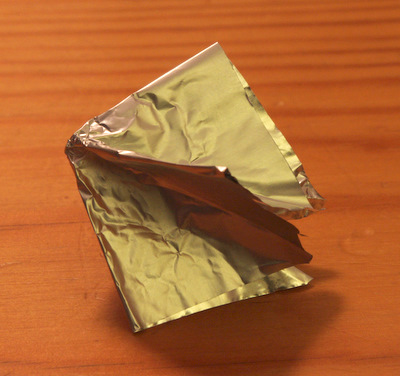
Use the scissors to cut a square piece of aluminum foil two inches on a side.

Fold it in half horizontally.

Fold it in half vertically.

Turn it over.

Fold it diagonally to the right.

Fold it diagonally to the left.

Now there are 8 creases radiating from the center of the square.

Fold each crease to create a diamond with four vanes.

Then unfold it a little bit to get the final pin wheel.

Push the eye of the needle into the eraser so the needle stands vertically with the point up.

Place the pinwheel on the tip of the needle.

Now that you've completed your psi wheel, try it out.

  • Sit at a desk or table away from anything that might create drafts such as an open window, fan, or air vent. Stray air currents might cause the psi wheel to move and would mask the effects of your hand.
  • If you want to use your right hand, put the psi wheel on the table a few inches to your right. If you want to use your left hand, put it on the table a few inches to your left. A psi wheel will respond to your hand better if it is not directly in front of your torso and if neither your hand or arm is directly in front of your torso.
  • Place the palm of your hand near the wheel (see the video below). Try to sit with your neck, shoulder, and arm relaxed. You may find it comfortable, if your chair has armrests, to put the wheel and your hand near the edge of table and your elbow on the armrest of the chair.
  • Getting the psi wheel to turn does not require any special powers. It should work for most people without any effort on their part beyond putting their hand near it. At first, it is usually best if you don't think about it or look at it or try to do anything to make it turn. Worrying about whether it will turn may have a negative effect. Try meditating with your eyes closed or reading something and after a minute or so look at the wheel to see if it is turning. The wheel will usually turn counter clockwise if you use your right hand and clockwise if you use your left hand. Once you experience it turning for a little while you will probably be able to watch it without inhibiting it.

If the wheel doesn't start turning after a minute or so, check the following:

Technical Issues:

  • Gently bump the wheel with your finger to make sure it spins freely and is balanced on the needle. Make sure the bottom points of the wheel do not bump into the eraser.
  • Try moving the wheel a little bit on the tip of the needle. This can be particularly helpful if the wheel turns one way and then the other repeatedly without completing a full revolution, or if the wheel slows down at the same point in every rotation. That type of behavior means the wheel is not balanced correctly and you can try to improve the balance by moving the wheel slightly with respect to the tip of the needle.
  • Be sure the psi wheel is not directly in front of your torso but is a few inches off to the side and use the hand on the same side of your body.
  • Make sure the wheel is not bumping into or in contact with your hand.
  • If the table or desk you are using is cluttered and there are objects, particularly metal objects, computer equipment, or electronic gadgets, near your hand, move them several inches away from your hand.
  • Try cutting out another piece of aluminum foil, make another wheel, and try that one.

Energy Field Issues:

  • Try relaxing your hand, or straightening your fingers, or spreading your fingers for a second or two.
  • Try putting the psi wheel on the other side of your body and using your other hand.
  • Go out for a walk for twenty minutes to an hour and try the psi wheel when you get back. Or, try some other type of mild exercise. This is probably the most important suggestion on this list, it is best way for a beginner to quickly increase his energy field.
  • Do qi gong exercises to strengthen your energy field.
  • If you are sleepy, fatigued, hungry, or ill, the wheel might not spin. Try later when you are feeling stronger.
If you can't get a homemade psi wheel to work, purchasing one at the link above may be a good alternative. The commercial ones turn with much less friction and are much easier to use. Reading the instructions for the Egely Wheel may also help you get your homemade wheel working. This article by Dr. Parisetti, which describes his experience learning to use a psi wheel, may also be helpful.

To use the psi wheel to practice spiritual healing, first you have to learn spiritual healing. My web site explains how to do that. I also suggest you read my article on A Synthesis of Spiritual Healing and Qi Gong which describes a good technique for improving your ability to use healing energy.

To use the psi wheel to practice spiritual healing, sit at a desk or table and imagine the spiritual healing energy coming down into you through the top of your head. Understand that the energy flows though your arms and out your hands, maintain loving intentions if possible, but your concentration should be primarily on the energy coming into you from above.

You can repeat a prayer such as one of these:

As you do this, place your hand near the psi wheel. If you have two psi wheels, you can use one with each hand (but they will probably turn slower than one alone so you may want to get some practice first before you try this with two wheels). It is usually better to close your eyes since thinking about the wheels will distract you from the healing meditation. However you can peek once in a while to see if the wheels are turning.

You should find that if you concentrate on the healing meditation, the psi wheel will turn, but if your mind wanders or you stop the flow of energy through your hands, the wheel will slow down or stop. Practicing this way should help you improve your concentration and develop your ability as a spiritual healer.

If you try using two psi wheels, one near each hand, and find one turns much faster than the other, or one does not turn at all, try the following:

  • Try just one psi wheel, and use it with the slow or stopped hand. Once it begins to turn well, try going back to two wheels.
  • If you are sleepy, fatigued, hungry, or ill try later when you are feeling stronger.
  • The problem may be due to a misalignment in the vertebrae of the neck. The nerves that go from the brain to the hand pass through the vertebrae of the neck. A misalignment in the neck vertebrae can adversely affect those nerves and reduce the hand's ability to turn a psi wheel. If you sometimes have discomfort in your neck, that could be a symptom of misaligned vertebrae. Try doing some gentle stretches to loosen the neck muscles: Move your head by looking up and then down several times. Then then tilt your head to the left and to the right several times. Then look to the left and to the right several times. A chiropractor can make a diagnosis and suggest exercises to help maintain correct alignment of the neck vertebrae.

When you are done with a session, you can store your psi wheels in an upside down jar. Place your psi wheels on the upside down lid and place the wheels on the lid. Then screw the upside down jar over them. This will allow them to be transported easily and protect them from damage and it will protect people from being accidentally stuck by the needles. (Click on the image below for a larger version.):

Copyright © 2012 by ncu9nc All rights reserved. Texts quoted from other sources are Copyright © by their owners.

Tuesday, July 31, 2012

Psychobiological theories do not explain Near Death Experiences

Near-Death Experiences Between Science and Prejudice by Enrico Facco and Christian Agrillo:

Several studies have proposed psychobiological interpretations of near-death experiences (NDEs), claiming that NDEs are a mere byproduct of brain functions gone awry; however, relevant facts incompatible with the ruling physicalist and reductionist stance have been often neglected. The awkward transcendent look of NDEs has deep epistemological implications, which call for: (a) keeping a rigorously neutral position, neither accepting nor refusing anything a priori; and (b) distinguishing facts from speculations and fallacies. Most available psychobiological interpretations remain so far speculations to be demonstrated, while brain disorders and/or drug administration in critical patients yield a well-known delirium in intensive care and anesthesia, the phenomenology of which is different from NDEs. Facts can be only true or false, never paranormal. In this sense, they cannot be refused a priori even when they appear implausible with respect to our current knowledge: any other stance implies the risk of turning knowledge into dogma and the adopted paradigm into a sort of theology.

The full article provides supporting information.

Copyright © 2012 by ncu9nc All rights reserved. Texts quoted from other sources are Copyright © by their owners.

Thursday, July 26, 2012

Charles Darwin was not an atheist, he believed in a form of Intelligent Design

I've updated the Eminent Researchers page on my web site to include a section on Charles Darwin.

Charles Darwin discovered the theory of evolution by natural selection. He was not an atheist, he was agnostic. He believed that one could not know if God existed or not. Darwin also believed that natural laws resulted from design which indicates that he believed in a form of Intelligent Design.

Wikiquote

Charles Robert Darwin (12 February 1809 – 19 April 1882) was an English naturalist who achieved lasting fame by outlining the theory of evolution and proposing that evolution could be explained through natural and sexual selection. Prompted by awareness that Alfred Russel Wallace was developing similar theories he published his own sooner than he had originally intended. This theory is now considered an integral component of biological science.
darwinproject.ac.uk
In my most extreme fluctuations I have never been an atheist in the sense of denying the existence of a God.— I think that generally (& more and more so as I grow older) but not always, that an agnostic would be the most correct description of my state of mind.
Wikipedia
Agnosticism is the view that the truth values of certain claims—especially claims about the existence or non-existence of any deity, but also other religious and metaphysical claims—are unknown and (so far as can be judged) unknowable.
Wikiquote
With respect to the theological view of the question: This is always painful to me. I am bewildered. I had no intention to write atheistically, but I own that I cannot see as plainly as others do, and as I should wish to do, evidence of design and beneficence on all sides of us. There seems to me too much misery in the world. I cannot persuade myself that a beneficent and omnipotent God would have designedly created the Ichneumonidae with the express intention of their feeding within the living bodies of caterpillars or that a cat should play with mice... On the other hand, I cannot anyhow be contented to view this wonderful universe, and especially the nature of man, and to conclude that everything is the result of brute force. I am inclined to look at everything as resulting from designed laws, with the details, whether good or bad, left to the working out of what we may call chance.

Copyright © 2012 by ncu9nc All rights reserved. Texts quoted from other sources are Copyright © by their owners.